Sourdough Bread
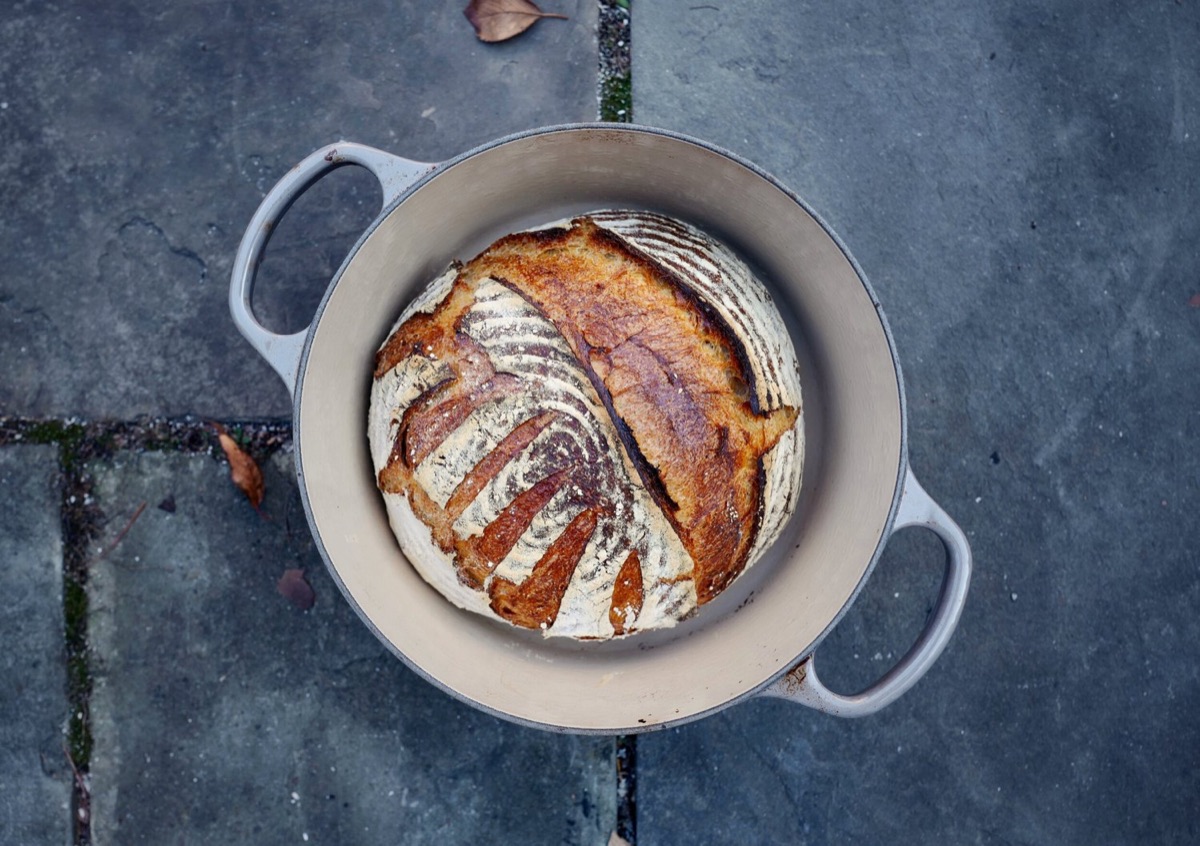
Many years ago, I had a short apprenticeship at a bakery in Chicago. The early morning hours were tough as a 25 year old, but I loved it. It was neat to see what went into bread-baking on a retail scale - big food storage tubs full of fermenting dough, the giant Hobart mixer, and a beautiful multi-tier, steam-injection oven.
The flipside of the experience was that I was no longer satisfied with my home bakes and decided it wasn’t really possible to make excellent bread at home. Luckily, other home bakers didn’t give up. Whether it’s starting out with no-knead breads, creating the perfect proofing environment at home, or mimicking a steam-injection oven - there are blogs, YouTube videos, and Reddit threads for every bread baking topic imaginable these days.
Like many people, 2020 ended up being the year I got back into sourdough bread. I try to bake a loaf every weekend and spent the first few months learning two wonderful, but slightly different recipes from Seawolf Bakery in Seattle and Tartine Bakery in San Francisco. I’ve arrived at a bit of a hybrid and a baking schedule that fits well into my week. I think the 25 year-old baking apprentice in me would be proud of what I’m producing at home these days.
Equipment
Jar (for starter)
Kitchen scale
Large bowl
Clean kitchen towels
Plastic wrap or shower caps
Banneton
Cast iron dutch oven
Parchment
Baking sheet
Optional
Stand-mixer
Dough whisk
Bench scraper
Ingredients
Flour 750 grams total (see below)
675 grams all-purpose flour
75 grams whole wheat flour
Water 500 g (warm)
Levain 150 g
Salt 15 g
Bakers’ Percentages
90% all-purpose flour
10% whole wheat flour
67% water
20% levain
2% salt
A NOTE ABOUT FLOURS: You really don’t have to use anything fancy. Regular all-purpose flour from the grocery store should work. It is fun to experiment with other flours once you get going though. Especially if you can support local farms like Meadowlark or Janie’s Mill. Lately, I’ve been using: King Arthur All-Purpose, King Arthur Bread Flour, or Meadowlark Bread Flour for my “all-purpose” and King Arthur Whole Wheat Flour or Meadowlark Rye Flour for the the “wheat.”
Before you can schedule your first bake, you’ll need to make sure you have sourdough starter. You can buy starter from places like King Arthur, but it is easy to make your own at home - or ask a friend for some of theirs! See the first part of Tartine’s Country Loaf recipe to learn how to make your own. Your starter will be equal parts water and flour, so it will be fairly liquid - this is okay.
Here is the baking schedule and high-level process I follow:
Thursday Morning
I pull my jar of starter out of the fridge and feed it with 1/4 C of flour and a 1/4 C of warm water. I let it sit at room temperature on the counter, covered with a clean kitchen towel. Once fed and active, a starter is often called a “levain.”
Thursday Evening
Feed the levain again using the same method as above.
Friday Morning
Feed the levain again using the same method as above.
Friday After Work
Levain
If the levain is bubbly and smells good, I do a water test. Put a spoonful of starter in a glass of water. If it floats, it’s ready to use. If not, keep feeding and resting until it does.
A NOTE ABOUT SOURDOUGH DISCARD: I don’t reduce my levain each time I feed it. Instead, once I’m ready to bake a sourdough loaf, I also bake banana bread using a version of this recipe that I have adapted. (I’ll post my version soon.) It’s a great way to use all of the excess levain without throwing any away - and it is excellent banana bread!
Once you’ve used the levain for these two baking projects, feed it again using the same ratios of flour and water, let it sit out for a few hours, and place it back into the fridge until next week.
Autolyse
Place a large bowl (I use the bowl of my Kitchenaid mixer) on a kitchen scale and begin to measure out all the ingredients listed above EXCEPT the salt.
Mix together by hand or with a dough whisk until there are no remaining clumps of raw flour.
Cover (a towel works, but I have a few cheap shower caps that I use) and let sit at room temperature for 30 - 60 min.
Mix
Scale salt and add to autolyse mixture.
Mix by hand or using a Kitchenaid mixer (with a dough hook on low) for 5 - 7 min. I use my mixer and typically pause to scrape down the sides and turn the dough once halfway through.
Bulk Ferment
Transfer dough to a clean, lightly oiled bowl or plastic tub. (A bench scraper can help here.) Cover and let rest for about 30 min.
A NOTE ABOUT TEMPERATURE: This is where temperature starts to be important. Ideally, the dough will rest in an environment that is around 75 - 85F. My oven has a “bread proof” setting, but I’ve found this is too warm at about 100F. Usually, I will set the oven to “bread proof” and leave the dough out of the oven, but nearby.
After 30 min, uncover the dough and do quarter folds (Step 7 here is a good description, or here is a video example). Recover and let rest another 30 min.
You’ll want to repeat this process until the dough increases in size and begins forming little air pockets. This usually takes me 2 - 3 hours (or 4 to 6 rest/turn cycles).
Overnight Fridge Rest
At this point, I retard the dough overnight in the fridge. Be sure to cover the dough with plastic wrap or a shower cap so that a crust doesn’t form.
Saturday Morning
Take the dough out of the fridge and leave it at room temperature for an hour or two. (The Saturday schedule is very relaxed.)
Board Shape
VERY lightly flour your counter or cutting board - you really don’t want to introduce more flour here, just ensure that the dough doesn’t stick.
Before turning your dough on the surface, you want to follow the process of quarter folks you used before, but this time, do six evenly spaced stretch/folks. Pinch the folds together at the base, and lift or turn out the dough onto the floured surface, seam side down.
Using your hands to create tension with the cutting board, gently roll the dough into a taut ball. (There are many YouTube videos that show this process).
Cover the dough with a clean kitchen down and rest for 2 - 3 hours.
Saturday Afternoon
Banneton Shape
Turn the dough over (seam side up).
Do another round of six stretch & folds.
Flip over the dough (seam side down) and shape into a taut ball.
Flip again (seam side up) and place into a lightly floured banneton. Pinch the seams together if needed.
Cover the dough with a clean kitchen down and rest for 30 - 60 min.
Prepare Oven
While the dough rests for the final time in the banneton, move racks to lowest part of the oven.
Place your dutch oven (with lid) in the oven and preheat to 450F.
A NOTE ABOUT DUTCH OVENS: I have a 5.5 qt Le Creuset, but Lodge has a cheaper option that people seem to love. The goal is to have something heavy that has a lid. This is what will create steam for your bread.
Final Steps
Place a sheet of parchment on the counter (I like to buy the hand pre-cut circles that fit my dutch oven).
Turn the dough out of the banneton and on to the parchment so that the seam side is down.
Score the bread using a razor blade or lame. Scissors will also work in a pinch.
Place dutch oven on stove, remove the lid, and carefully drop in the dough using the edges of the parchment. Replace lid (careful - it’s hot!) and place back in the oven.
Bake
Bake covered for 20 min.
Remove the lid, rotate the dutch oven, and place a baking sheet under dutch oven (on the second rack in the lowest spot of the oven). Bake for 20 min.
Rotate the dutch oven and back for 10 - 20 more min. You want a deep color, so resist the urge to pull it out too early. You don’t want it to burn of course, so use your judgment. The top edges of my cuts are sometimes almost burnt, but main surface area is a beautiful caramel color.
Cool
Your dough will keep baking after it is out of the oven. Place on a wire rack and allow to cool completely. If you’ve been following this schedule, you should be able to let it cool for several hours, but still enjoy it with your Saturday dinner.
Storage
I store my bread in linen drawstring bags and it stays fresh for several days.